A Complete Guide to Every Sweetener You Need to Know
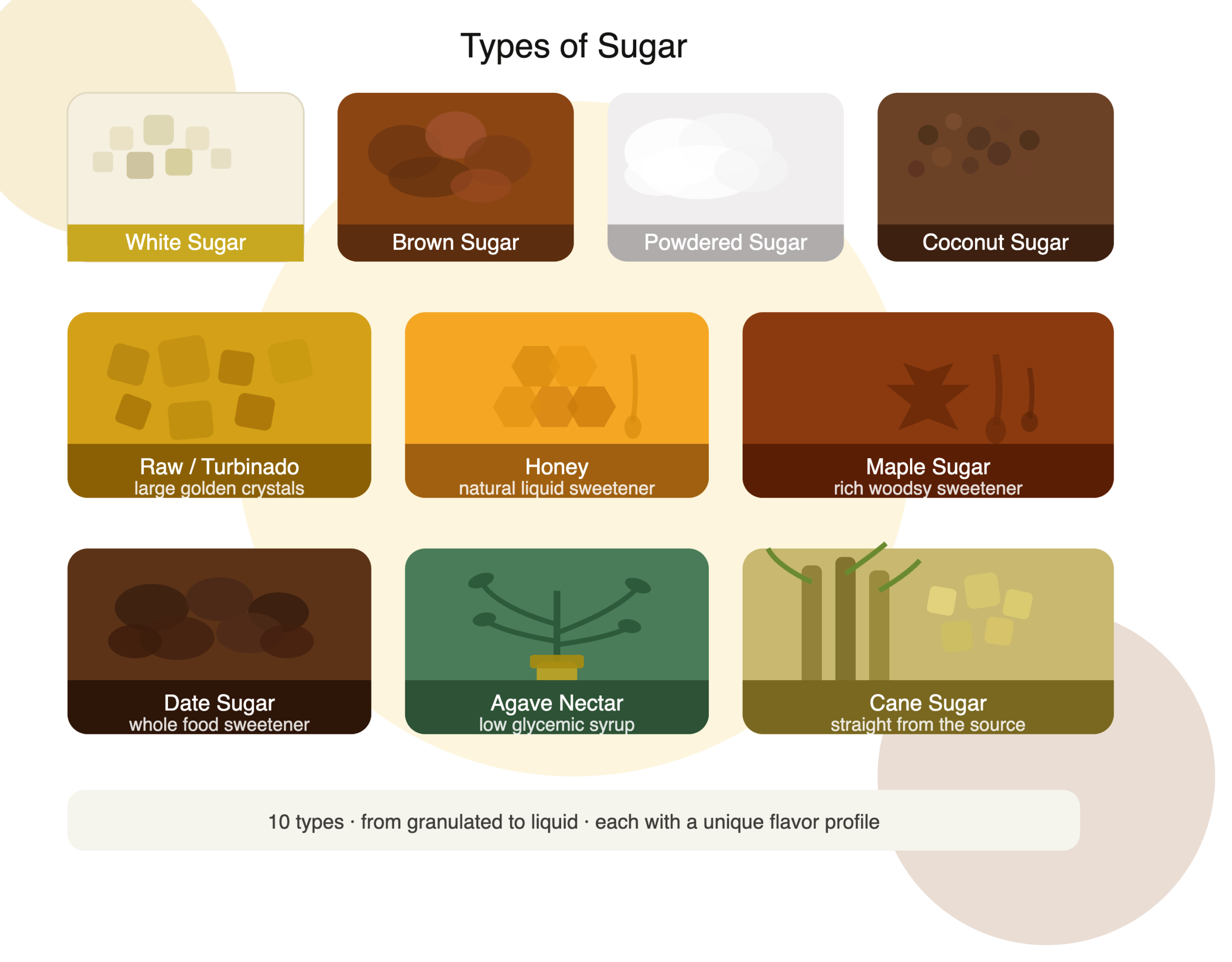
Whether you’re baking a birthday cake, sweetening your morning coffee, or reading a nutrition label, sugar is everywhere. But not all sugars are the same. From the granulated white sugar in your pantry to the exotic coconut sugar at the health food store, each type has a distinct flavor, texture, and use case — and different effects on your health.
This guide breaks down every major type of sugar so you can make smarter choices in the kitchen and beyond.
What Is Sugar?
Sugar is a broad term for sweet-tasting carbohydrates. At the molecular level, sugars are either monosaccharides (single sugar units like glucose and fructose) or disaccharides (two units bonded together, like sucrose and lactose). Both occur naturally in foods and can be refined into the sweeteners we use every day.
1. White Granulated Sugar
The most common sugar in the world.
White granulated sugar is refined from sugarcane or sugar beets. During processing, molasses is removed, leaving pure sucrose crystals. It dissolves easily, has a neutral sweetness, and is the go-to for baking, cooking, and beverages.
- Glycemic Index (GI): ~65
- Best for: Baking, beverages, sauces, preserves
- Flavor: Clean, neutral sweet
2. Brown Sugar
White sugar with a molasses comeback.
Brown sugar is essentially white sugar with some molasses added back in. Light brown sugar has about 3.5% molasses; dark brown sugar has around 6.5%. The molasses gives it a moist texture and a rich, caramel-like flavor.
- GI: ~64
- Best for: Cookies, marinades, BBQ sauces, oatmeal
- Flavor: Warm, caramel, slightly earthy
3. Powdered Sugar (Confectioner’s Sugar / Icing Sugar)
The baker’s secret weapon.
Powdered sugar is finely ground white sugar mixed with a small amount of cornstarch to prevent clumping. Its ultra-fine texture makes it ideal for icings and frostings that need to be silky smooth.
- Best for: Frosting, dusting desserts, whipped cream, macarons
- Tip: Don’t substitute it 1:1 for granulated sugar — the cornstarch changes textures in baked goods.
4. Raw Sugar (Turbinado / Demerara / Muscovado)
Less refined, more character.
Raw sugars are minimally processed, retaining some natural molasses. They come in several varieties:
- Turbinado: Light golden crystals, mild molasses flavor. Great for coffee and tea.
- Demerara: Coarser and crunchier, used for topping muffins and crumbles.
- Muscovado: Dark and sticky with an intense molasses punch. Excellent in gingerbread and dark sauces.
- GI: ~65 (similar to white sugar)
- Best for: Coffee, baking toppings, specialty recipes
5. Coconut Sugar
The trendy alternative sweetener.
Made from the sap of coconut palm blossoms, coconut sugar is minimally processed and retains trace minerals like iron, zinc, and potassium. It has a subtle caramel-like taste and a lower GI than regular sugar.
- GI: ~35 (varies by source)
- Best for: Baking, smoothies, Asian recipes
- Note: Still high in calories — not a “free” health food.
6. Cane Sugar
A step closer to the source.
Cane sugar is made exclusively from sugarcane (as opposed to sugar beets). Varieties like “evaporated cane juice” or “raw cane sugar” are slightly less refined than white sugar and may retain a hint of molasses flavor.
- Best for: Everyday baking and cooking where you want a slight upgrade from white sugar
7. Fructose
The fruit sugar — naturally occurring and highly concentrated.
Fructose is the natural sugar found in fruit, honey, and some vegetables. It’s also produced commercially as high-fructose corn syrup (HFCS), which is widely used in processed foods and sodas. While fructose has a lower GI than glucose (because it’s processed in the liver), excessive intake — especially from HFCS — is linked to metabolic concerns.
- GI: ~19 (pure fructose)
- Found in: Fruit, honey, agave, processed foods (as HFCS)
8. Glucose (Dextrose)
The body’s primary fuel.
Glucose is the simplest form of sugar and the body’s preferred energy source. Commercially, it’s sold as dextrose powder and used in sports drinks, candy making, and medical applications (like IV fluids).
- GI: 100 (the benchmark)
- Best for: Candy making (prevents crystallization), sports nutrition, brewing
9. Lactose
The sugar in milk.
Lactose is a disaccharide found naturally in dairy products. It’s made of glucose + galactose. People with lactose intolerance lack the enzyme (lactase) needed to digest it. It’s rarely used as a standalone sweetener.
- Found in: Milk, yogurt, cheese, ice cream
10. Maple Sugar
Liquid gold in solid form.
Maple sugar is made by evaporating nearly all the water from pure maple syrup. It has a distinctive, rich maple flavor and can be used as a 1:1 substitute for white sugar in most recipes.
- GI: ~54
- Best for: Oatmeal, baking, spice rubs, coffee
- Flavor: Deep, woodsy, caramel
11. Date Sugar
Whole food sweetness.
Date sugar is made from dried, ground dates — making it one of the few sugars that retains fiber. It doesn’t dissolve well in liquids, but adds incredible depth to baked goods.
- Best for: Cookies, energy bars, muffins
- Bonus: Contains fiber and trace nutrients from whole dates
12. Honey
Nature’s oldest sweetener.
Technically not a “sugar” by strict definition, honey is a natural sweetener made by bees from flower nectar. It contains fructose, glucose, and small amounts of vitamins, minerals, and antioxidants. Raw honey offers the most health benefits.
- GI: ~50–60 (varies by type)
- Best for: Tea, dressings, marinades, toast, baking
- Note: Has a distinct flavor that affects recipes; use less than white sugar.
13. Agave Nectar (Agave Syrup)
A controversial “health” sweetener.
Agave syrup comes from the blue agave plant (the same plant used to make tequila). It’s very high in fructose (~70–90%), which gives it a low GI — but that also means it’s processed almost entirely by the liver, raising concerns about long-term metabolic health with heavy use.
- GI: ~15–30
- Best for: Cocktails, salad dressings, vegan baking
- Caution: Low GI doesn’t mean low risk in large amounts.
Sugar vs. Sugar Substitutes: What’s the Difference?
The sugars above are all caloric sweeteners derived from natural sources. Sugar substitutes (like stevia, erythritol, xylitol, monk fruit, and aspartame) are a separate category — either zero-calorie artificial sweeteners or low-calorie natural alternatives. They work differently in baking and have their own health profiles.
How to Choose the Right Sugar
| Goal | Best Sugar Choice |
|---|---|
| Everyday baking | White granulated or cane sugar |
| Rich, moist cookies | Brown sugar or muscovado |
| Lower glycemic option | Coconut sugar or maple sugar |
| Whole food sweetener | Date sugar or raw honey |
| Smooth frosting | Powdered sugar |
| Coffee topping | Turbinado or demerara |
| Asian cooking | Palm sugar or coconut sugar |
The Bottom Line
Sugar comes in dozens of forms each with its own flavor profile, texture, glycemic impact, and best-use scenarios. While no sugar is truly a “health food” in large amounts, understanding the differences helps you cook better, bake smarter, and read food labels with more confidence.
The best sugar is the one that fits your recipe, your palate, and your dietary goals. Start experimenting, and you might just discover that swapping white sugar for muscovado or maple sugar completely transforms a recipe you’ve made a hundred times.