Jaggery, known as gur in Hindi, is one of India’s oldest natural sweeteners. It is made by boiling and evaporating sugarcane juice or palm sap without refining it, which means it retains iron, magnesium, potassium, and natural molasses. But today’s market is full of adulterated jaggery laced with bleaching agents, fillers, and artificial colours. Knowing how to spot the difference protects your health and ensures you get the real nutritional benefit.
What Is Jaggery Adulteration and Why Does It Happen?
Manufacturers adulterate jaggery mainly for two reasons: appearance and profit. Many consumers associate light yellow or golden jaggery with freshness and purity, so producers use chemical bleaching agents to achieve that look. Others add cheap fillers to increase weight and reduce cost. Common adulterants include sodium hydrosulphite (a bleaching agent), washing soda, chalk powder, calcium sulphate, artificial colours, and plain refined sugar syrup.
Visual and Sensory Signs to Check First
Before running any test, use your senses.
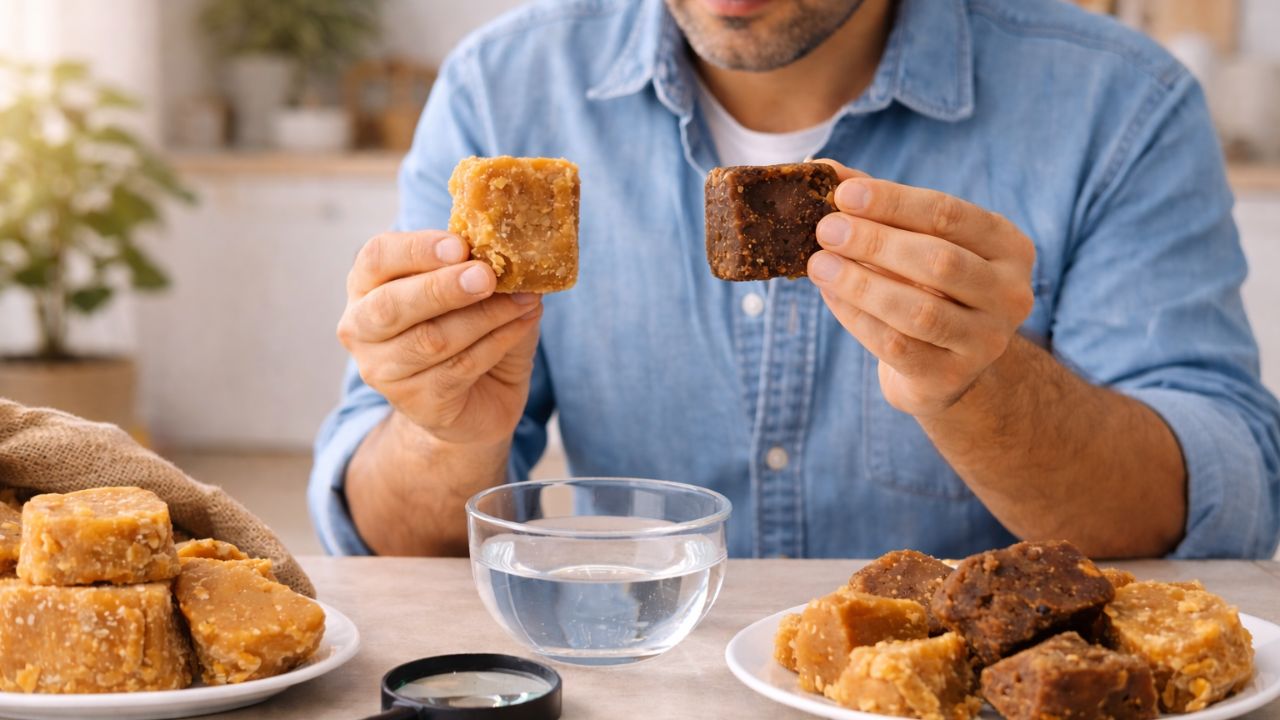
Pure jaggery is dark brown to golden amber in colour. It has a slightly grainy or rough texture, a rich earthy and molasses-like aroma, and a natural sweetness with a mild bitter undertone. It melts cleanly without leaving a cloudy residue.
Adulterated jaggery often appears unnaturally bright yellow or pale white. It feels too smooth or waxy, has little to no aroma, and may leave a sharp chemical or metallic aftertaste. When dissolved in water, it often leaves a muddy or milky sediment.
Note that colour alone is not conclusive. Some pure jaggery is light depending on the cane variety or harvest season. Always pair visual checks with the tests below.
5 Simple Home Tests to Detect Adulteration
1. Water Dissolution Test
Dissolve a small piece of jaggery in a glass of warm water. Pure jaggery turns the water a clear amber-brown with no sediment. If you see a milky, cloudy, or muddy residue settling at the bottom, chalk powder or calcium sulphate has been added.
2. Vinegar or Lime Juice Test (for chalk)
Drop a small piece of jaggery into a teaspoon of vinegar or lime juice. If it fizzes or bubbles vigorously, chalk powder (calcium carbonate) is present. It reacts with acids to release carbon dioxide. Pure jaggery produces no reaction.
3. Flame Test (for bleaching agents)
Place a small piece on a metal spoon and heat it gently over a flame. Pure jaggery caramelises into a deep brown liquid with a sweet aroma. If the jaggery turns green or black or gives off a pungent chemical smell, sodium hydrosulphite or another bleaching chemical is present.
4. Turmeric Test (for washing soda)
Make a thin paste of jaggery with a little water. Apply a pinch of turmeric powder and wait five minutes. If the turmeric stays yellow, the jaggery is clean. If it turns bright reddish-orange, washing soda (an alkali) is present. This happens because curcumin in turmeric changes colour in alkaline conditions.
5. Taste and Texture Test
Press a small piece between your fingers. Pure jaggery is slightly sticky and grainy. Taste it slowly. It should have a natural, layered sweetness with an earthy or molasses note and no aftertaste. If it feels smooth or waxy, tastes overly sweet, or leaves a harsh chemical taste, it has likely been processed with additives.
Common Adulterants and Their Health Risks
Sodium hydrosulphite is used for bleaching. Long-term exposure can cause respiratory problems and kidney stress. Detected by the flame test.
Washing soda (sodium carbonate) is added to increase weight. It irritates the gut lining and causes digestive issues. Detected by the turmeric test.
Chalk powder or calcium sulphate is used as a filler. It can contribute to kidney stones and interferes with mineral absorption. Detected by the water test and vinegar test.
Artificial colours and metanil yellow are used to improve appearance. Metanil yellow is a coal tar dye that is neurotoxic and potentially carcinogenic with prolonged exposure.
Refined sugar syrup is added to bulk up the product cheaply. It strips away the nutritional value that makes jaggery healthier than white sugar in the first place.
Tips for Buying Pure Jaggery
Choose darker jaggery. Deep golden-brown to dark brown shades indicate retained molasses and minimal processing. Very pale or bright yellow jaggery has almost certainly been bleached.
Buy from trusted local sources such as organic farms, certified brands, or traditional jaggery makers (kolhu). Mass-market packaged products of unknown origin carry higher risk.
In India, look for the FSSAI licence number on packaged jaggery. It means the product has been inspected under food safety regulations.
Avoid blocks that look perfectly uniform in shape, size, and colour. Natural jaggery varies. Uniformity often signals industrial processing with additives.
Smell the jaggery before buying. Pure jaggery has a distinct sweet, earthy, slightly smoky aroma. No smell or a chemical odour is a red flag.
Prefer jaggery made in winter, between November and February, when fresh sugarcane is harvested. This is when quality and purity tend to be highest.
Certified organic jaggery prohibits chemical bleaching agents and synthetic additives by standard, making it a safer option.
Frequently Asked Questions
Is light-coloured jaggery always adulterated?
Not always. Some cane varieties naturally produce lighter jaggery. But if the colour is very pale yellow or white, bleaching is very likely. Always confirm with the flame or water test.
Is organic jaggery always pure?
Certified organic jaggery is held to strict standards that ban chemical additives. While the label alone is not a guarantee, it significantly reduces the risk compared to unlabelled products.
Can I detect adulteration without tests?
Sight, smell, and taste give you useful clues but are not conclusive on their own. The water test and flame test together take under five minutes and are reliable enough for most situations.
What is the best form to buy?
Block or lump jaggery is generally safer than powder, which is easier to adulterate with invisible fillers. If buying powder, ensure it comes from a certified source and has a strong natural aroma.
Does pure jaggery have real health benefits over sugar?
Yes. Pure jaggery contains iron, magnesium, potassium, and small amounts of B vitamins. Refined sugar has none of these. Jaggery also has a slightly lower glycaemic index, though it should still be eaten in moderation.
Pure jaggery is not hard to find once you know what to look for. A few seconds of observation and a quick home test are all it takes to protect yourself from adulterated products and enjoy the real thing.